Micro Lenders

  • Subscribe to our RSS feed.
  • Twitter
  • StumbleUpon
  • Reddit
  • Facebook
  • Digg

Wednesday, 30 October 2013

Will Somali Pirates Return if EU Stops Patrolling Soon?

Posted on 10:13 by Unknown
Ahoy mateys, it's back to the Gulf of Aden for us in this post. The collapse of a functioning government in Somalia led to a period when many turned to piracy as a lucrative livelihood in the absence of other viable sources of income. Americans--people who top the global list of ignoramuses about what's going on in the world--even focused some attention on the issue with the kidnap of Captain Richard Phillips of the MV Maersk Alabama. They even made a movie about it (just don't ask them where Maersk is headquartered since the average Yank probably can't find Denmark on the map, let alone Somalia.)

In any event, EU-led efforts to patrol these lawless seas eventually bore fruit, with piracy receding to far less alarming levels in the last year. With EU Navfor's mandate winding up in 2014, however, there is concern that the pirates will come back strong once the cats are away. Back in the UK, Labour's Shadow Foreign Secretary John Spellar has voiced this very concern. (For non-Brits, a "shadow" minister is someone from the opposition whose portfolio is similar to the "real" minister's except s/he is obviously not in power.) From the industry publication Lloyd's List:
A senior UK official has urged the shipping industry to lobby to extend the mandate of EU Navfor’s Operation Atalanta beyond its 2014 mandate deadline.

The shadow foreign and commonwealth office minister John Spellar warned that “EU Navfor’s Operation Atalanta will be renegotiated in 2014 and it is not clear whether it will be maintained”.
Addressing the Security in Complex Environments conference in London, Mr Spellar revealed that politicians had complained that multiple forces patrolling the high-risk area duplicate each others’ efforts rather than complement each other. “There are voices in the back benches that question why we need UK co-operation when there is [North Atlantic Treaty Organisation] involvement,” he said.
Unsurprisingly, most shipping industry interests are lobbying for EU Navfor to stick around:
Mr Speller warned that some government departments are slow to react to changing circumstances and urged the shipping industry to lobby the government as soon as possible to extend Operation Atalanta. “It is important to get [government] engaged at the earliest possible stage,” he said.
A representative from Mitsui OSK Lines based in London said operators needed EU Navfor forces to stay in place. “If we lose that capability the pirates will come back. It’s as simple as that,” he said.
I think the chances are good that EU Navfor will gain an extended mandate in 2014. While the reduction in piracy is also due to a host of other factors alike more commercial vessels having armed guards and designating traffic zones where pirates are less likely to be successful, European patrolling is clearly valued by industry players. Moreover, I am not convinced that playing Britney Spears music [?!] will drive the evildoers away. 

Ops, I hope they don't do it again.
Read More
Posted in Africa, Europe, Trade | No comments

Tuesday, 29 October 2013

Colonial Mentality: Chinese Shun Their Own Brands

Posted on 02:11 by Unknown
Given the truckload of goods China makes for the rest of the world, it may seem odd that the Chinese are concerned with their inability to develop homegrown brands: Why should you develop your own brands when Apple/General Electric/Samsung and whoever else have you have done the heavy lifting of brand-building for you as a contract manufacturer? It's certainly not easy, either--none of the world's top 100 brands are mainland Chinese. The answer is as simple as it is clear: actually making consumer goods constitutes an ever-decreasing share of the profits--if any. The higher value-added activities come from branding, marketing and goodwill which emanate from (surprise!) building up a brand name. In other words, the Chinese get the grunt work and the industrial pollution, while Western companies get the cushy high-salaried jobs and clean air.

Just in time, the FT has an article discussing how the Chinese perpetuate this lamentable situation themselves by preferring imported to local brands. In sociology, it would be classified under "colonial mentality" or believing that former colonizers--be they the Japanese or the Europeans--are superior. After all, they managed to colonize you, right?
Chinese consumers want foreign goods. Whether sports shoes or cars, televisions or mobile phones, cosmetics or nappies [diapers to non-Brits], surveys show that foreign brands predominate. Shaun Rein of China Market Research Group says people trust foreign brands not to cut corners and associate them with more of an established heritage than their domestic labels.

This spells trouble for China as its people become more middle-class and spend more on non-essential items. The more that they buy foreign goods, the more that the proceeds of China’s progress will accumulate to shareholders elsewhere. It will also mean fewer profits for Chinese companies to reinvest in innovation and expertise at home in electronics, for example.
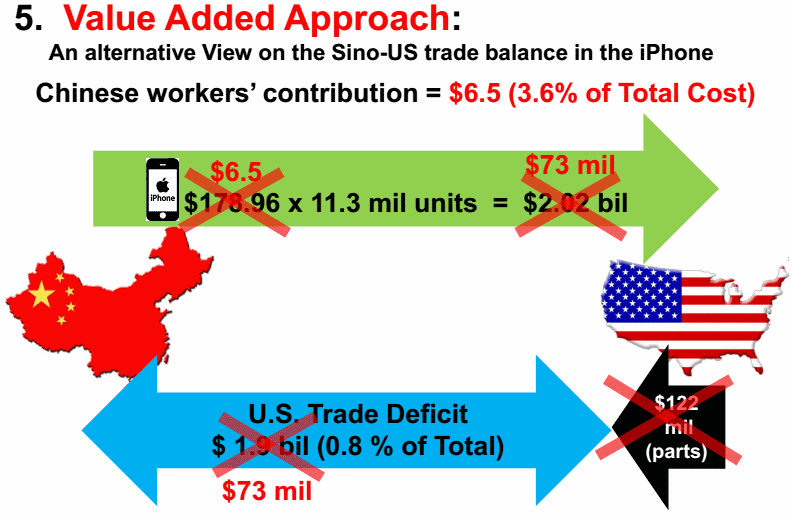
Moreover, there is the matter of "sham" trade surpluses (the image above comes from the ADB Institute): trade figures aside, once you adjust for the actual value-added of Chinese exports, the results look rather less impressive:
Its lack of popular brands is already visible to some degree in its trade balances with other countries. China may run a large nominal surplus but when economists adjust those numbers for the value that it adds or gives away in making goods that are consumed at home or abroad, the numbers tell a very different story.

For example, its total trade surplus with the US drops from $189bn to $127bn on a value-added basis, according to calculations by economists at BBVA, the Spanish bank. Most of this reduction is due to value given away in electrical and optical equipment, textiles and clothing.
Consider it as a warning sign. Sometime ago, I wrote a journal article together with a marketing scholar about the pressing need for the likes of China to develop brands of its own. Suffice to say that message has gone unheeded, and things may get worse in terms of prospects for Chinese development going forward if this matter is not addressed:
If China can follow its neighbours and develop its own powerful brands like Samsung of South Korea, or Toyota of Japan, it can sell not only to its own 1.35bn people but to billions of others all over the world.
If it does not build or buy such brands there is a risk that its consistent trade surpluses will become deficits in the decades ahead. That is not what the push to rebalance China’s economy towards consumerism is supposed to do.
Consider these folks warned. After all, if you don't buy your own brands, what confidence will others have in them?
Read More
Posted in China, Marketing, Trade | No comments

Sunday, 27 October 2013

Post-Crisis, What are the World's Safest Banks?

Posted on 09:49 by Unknown
Your initial reaction will likely be the same as mine: Who are these guys?  After years dabbling in own-account speculation, derivatives and other get-rich-quick schemes, the stalwarts from days gone by are no longer on this list. Deutsche Bank? You must be joking. American money center banks? Get outta here! Instead, we have an interesting combination of European banks with government ownership and Singaporean banks with conservative practices. From the press blurb:
The safest 10 banks in the world are all European, just as they were last year and the year before that. However, in all but one case, that safety arises largely as a result of ownership by a European government or sponsorship by government-related entities. Of the 10 banks that lead this year’s rankings of the World’s Safest Banks, only one, Rabobank, is privately owned.

As in recent years, Germany’s KfW heads the rankings, though four other institutions also have AAA ratings from Fitch, Moody’s and Standard & Poor’s (S&P): Bank Nederlandse Gemeenten, Zürcher Kantonalbank, Landwirtschaftliche Rentenbank and L-Bank.

No privately owned bank holds a Triple-A rating from any of the three agencies, although four have an Aa1 from Moody’s: TD Bank Group and the three leading Singaporean banks, DBS Bank, Oversea-Chinese Banking Corporation and United Overseas Bank. Neither Fitch nor Standard & Poor’s assigns AA+ ratings to any private bank.
Global Finance's rankings are based on ratings of the three major agencies, by the way. My intuition is not so much that government ownership guarantees the safety of the aforementioned European banks (sorry, WSJ Deal Journal), but by charter or mandate they are required to maintain conservative banking practices. In other words, they tend to stick to the low risk spectrum with its accompanying implications for reward (at least in a short-term sense). Hence, I am puzzled as to why the privately-owned Rabobank cracks the top 10, not least because it's been implicated in the LIBOR-fixing in a big way. Go figure.
Read More
Posted in Europe | No comments

Thursday, 24 October 2013

China's 'Maritime Silk Road' as a Hegemonic Project

Posted on 02:12 by Unknown
 The wrangling over both the US government shutdown and the debt ceiling caused Barack Obama to cancel his attendance at the annual Asia-Pacific Economic Cooperation (APEC) shindig being held this year in Bali, Indonesia. So he stayed at home to deal with a localized insurrection led by an angry, mostly whitebread crowd, "Tea Party" members, they call themselves. Just desserts, I say. His absence triggered yet another round of commentary about the existence of American hegemony in general and its alleged "pivot to Asia" in particular. Some say the absence does not matter; others think it's a culmination of US decline.

At any rate, this notable omission only served to highlight China's latest plan (gimmick?) to curry favor with other nations in the Asia-Pacific. After having its Noughties-era outreach efforts to ink economic agreements alike free trade deals undermined by its strident assertions to territorial disputes in the South China Sea and East China Sea, the PRC seems to attempting to return to a more diplomatic approach. The Silk Road was named after the commercial routes plied by China when it was an empire. At APEC, keynote speaker Xi Jingping's main talking point concerned the "Maritime Silk Road" which once again promises improved relations with neighbors through commercial ties.
On Oct. 3 during his trip in Indonesia, Xi [Jingping] said in a speech that China and the ASEAN will promote maritime cooperation and build a 21st-century maritime Silk Road. This was also brought up by Li [Keqiang] in his seven-point proposal on China-ASEAN cooperation in Brunei on Wednesday. [B]uilding a maritime Silk Road will involve a new consensus, including discussing the signing of a treaty on good neighborliness, friendship and cooperation, strengthening security exchanges, setting up an Asian infrastructure investment bank and prioritizing maritime connectivity development...

In the seven-point proposal, Li [Keqiang] said "the two sides should launch negotiations on upgrading their free trade area and strive to bring bilateral trade to one trillion U.S. dollars by 2020 so as to allow ASEAN countries to benefit more from regional integration and China's economic growth." Zhang Jiuhuan, former Chinese ambassador to Thailand, Singapore and Nepal, said, "Upgrading the free trade area is another significant step for the Chinese government to beef up China-ASEAN cooperation." 
President Xi and Premier Li have been flogging this idea for many months in ASEAN countries, although they have not yet taken it to the Philippines and Vietnam with which it has the most pronounced maritime disputes in Southeast Asia. Still, they allude to the success of the China-ASEAN FTA which they wish to use expand and use as a focal point in strengthening ties:
Starting operation in 2010, the China-ASEAN free trade area is the largest one among developing countries. China is the largest trading partner for ASEAN, and the association is the third largest trading partner for China. According to Zhang, bilateral trade volume between China and the ASEAN grew from 78.2 billion U.S. dollars in 2003 to 400.1 billion U.S. dollars in 2012. Volume reached 210.56 billion U.S. dollars in the first half of this year, up 12.2 percent year on year.

Zhang said "upgrading the free trade area" is needed for both sides. He said the area will help improve the trade of commodities and services and investment cooperation in order to provide convenience and freedom. "All-dimensional cooperation will create more favorable conditions for the maritime Silk Road," said Zhang. "China's economic growth will also bring about more opportunities." 
The idea remains the same in a liberal sense: improved economic ties will smoothen relations--including frayed ones over territorial disputes. However, reception of the Maritime Silk Road idea is mixed among Southeast Asian countries as you would expect: Malaysians are more sanguine, but then again their territorial conflicts with China are not particularly heated. How successful can the Maritime Silk Road project be in calming neighbors? I personally believe that building more economic ties is welcome, but they will be accompanied by more guarded opinions of China's broader intentions. That is, for how long can it afford to give security matters lesser priority while the "security dilemma" the PRC has created makes others feel insecure?
President Xi Jinping and Premier Li have toured ASEAN extensively; it reflects their strategic outlook of developing relationships with neighbouring countries. The new leadership is trying to diffuse tension in the SCS by using various techniques, of which MSR is one. However, a revival of the MSR looks bleak. Also, earlier the route was used for the import of precious stone, wood and spices but today it will used for oil and gas, which is directly connected to the energy security of not one but many countries. There is an emerging security architecture in the region which has led to an increased arms build-up, and the assertiveness of new regional powers has further complicated the regional military balance, which makes the MSR an unlikely prospect.
Moreover, isn't this the same China that disinvited the Philippine president from participating in a trade mission due to the South China Sea imbroglio? More commerce is welcome, but I believe that economic and security matters are becoming less positively correlated in terms of Sino-ASEAN dynamics. That is, stronger economic ties do not necessarily imply improved security ties. Remember, trade has been increasing against a backdrop of worsening conflicts over the South China Sea with the Philippines and Vietnam especially.

Lastly, wasn't the Silk Road at its height when China effectively enforced a tributary system on others in the region? Perhaps the metaphor China has chosen is not a good one since its original iteration had others accepting their subordinate position relative to the Middle Kingdom. The PRC always says it does not seek hegemony (alike white people do), but it has given the rest of us reason to doubt.
Read More
Posted in China, Hegemony, Security, Southeast Asia, Trade | No comments

Tuesday, 22 October 2013

Hong Kong, World's Freest Economy 42 Years Running

Posted on 06:18 by Unknown
I guess some things in life are inevitable: Canada's Fraser Institute, watchdog of economic freedom the world over, has designated the special administrative region (formerly a crown colony) of Hong Kong the world's freest economy for a 42nd consecutive year.  This matter is of special interest given how HK's most famous businessman is warning that too much clamor for political freedom may dent this vaunted reputation for economic freedom. Think of the political free-for-all Stateside--a moronic version of political expression from all sides--and you catch his drift.

Speaking of which, the United States is zooming down the index at a rapid clip. Talk about American decline:
Hong Kong again topped the rankings of 151 countries and territories, followed by Singapore, New Zealand, and Switzerland in the Fraser Institute’s annual Economic Freedom of the World report. The United States, once considered a bastion of eco nomic freedom, now ranks 17th in the world. “Unfortunately for the United States, we’ve seen overspending, weakening rule of law, and regulatory overkill on the part of the U.S . government, causing its economic freedom score to plummet in recent years.

This is a stark contrast from 2000, when the U.S. was considered one of the most economically free nations and ranked second globally,” said Fred McMahon, Dr. Michael A. Walker Research Chair in Economic Freedom with the Fraser Institute. 
Despite how bad things are in the godawful US of A, there is always worse. Venezuela ranks dead last. Fortunately for it, the likes of Cuba and North Korea were not surveyed for lack of data:
Venezuela has the lowest level of economic freedom worldwide, with Myanmar, Republic of Congo, Zimbabwe, and Chad rounding out the bottom five countries. Some nations, like North Korea and Cuba, could not be ranked because of a lack of data.
The Fraser Institute gives me a new tagline for the United States: America, where you can have as much TP as you want! So it's not quite the commercial success story that's Hong Kong, but things could be rather worse...
Read More
Posted in Casino Capitalism | No comments

Monday, 21 October 2013

Contrarian Thoughts: Depopulation's Benefits

Posted on 03:38 by Unknown
The essence of dramatic tragedy is not unhappiness. It resides in the solemnity of the remorseless working of things - Alfred North Whitehead as quoted by Garrett Hardin in The Tragedy of the Commons

While doing research on an environmentally-related issue, it occurred to me to re-read the famous article concerning the tragedy of the commons by Garrett Hardin. Unbeknownst to many, he was not only concerned with collective environmental abuse but also overpopulation--on which he voiced many politically incorrect opinions. However, questions of demography remain foremost as the world's population has zoomed past 7 billion and the consequences of anthropogenic activity on the environment capture the world's attention.

In many recent posts, I have treated "Detroitification" as shorthand for demise. Fewer and fewer people implies lower and lower economic growth. But, what if we recognize the finitude of economic growth as a consequence of finite resources? It would follow that fewer people may be more desirable. What's more, overpopulating a country, town or what else have you may be a strategy of maximizing one's welfare while reducing that of the broader (world) community--precisely, a tragedy of the commons:
Work calories are used not only for what we call work in common speech; they are also required for all forms of enjoyment, from swimming and automobile racing to playing music and writing poetry. If our goal is to maximize population it is obvious what we must do: We must make the work calories per person approach as close to zero as possible. No gourmet meals, no vacations, no sports, no music, no literature, no art. ... I think that everyone will grant, without argument or proof, that maximizing population does not maximize goods.
Hardin's potential insight is that the more people = more economic growth equation does not hold at a global level given the proverbial limits to growth. Consider, also, the world situation circa 1968 when the article was written:
Has any cultural group solved this practical problem at the present time, even on an intuitive level? One simple fact proves that none has: there is no prosperous population in the world today that has, and has had for some time, a growth rate of zero. Any people that has intuitively identified its optimum point will soon reach it, after which its growth rate becomes and remains zero. 

Of course, a positive growth rate might be taken as evidence that a population is below its optimum. However, by any reasonable standards, the most rapidly growing populations on earth today are (in general) the most miserable. This association (which need not be invariable) casts doubt on the optimistic assumption that the positive growth rate of a population is evidence that it has yet to reach its optimum.
In 2013 we have reached the point where there are any number of "prosperous" populations which have growth rates approaching zero in Western Europe as well as the East Asian tigers--Hong Kong, Singapore, South Korea and Taiwan. And then there's Japan which is already depopulating at a fairly rapid clip but remains the world's third largest economy.

Instead of feeling sorry for them or bemoaning their lack of growth, perhaps the environmentally and morally appropriate response would be to welcome their contribution to sustainability. In effect, they sacrifice national well-being by old metrics alike GDP growth for the sake of not lessening the world's carrying capacity.

Just a thought for you from a reading on Hardin.
Read More
Posted in Environment, Japan | No comments

Sunday, 20 October 2013

Why are the World's Best Central Bankers All Asian?

Posted on 03:09 by Unknown
Ben Bernanke is the world's leading practitioner of what I call "Jive-A** Central Banking." It involves creating vast negative externalities for others. Easy money policies Stateside have not only led others to justifiably accuse the Fed of beggar-thy-neighbor policies via competitive devaluation (which he denies), but also cause further turmoil in the Hamlet-style drama of whether to end them or not. Suffice to say that these unconventional measures have done little to put the United States on a firm economic footing, let alone a sustainable path for growth.

Recently, Global Finance released this year's list of the world's best central bankers, a sort of Pro Bowl for central banking. In a sign that the "Asian Century" has come to central banking at least, all of the featured top vote-getters were from Asia. (Perennial selection Mark Carney famously moved to the UK from Canada so the jury is still out on him.) Again, I believe this points out that since the Asian financial crisis, these states have learned their lessons about prudent monetary policy in the face of unusual situations: avoidance of extremely negative real interest rates, balance sheet abuse, market-misleading pronouncements and so on. Prudent central banking is not exactly a mystery; why so many violate sound practices is quite frankly galling.

Obviously none of these holds insofar as Ben Bernanke is concerned. Faced with its own crisis, the United States has embarked on Wild West experiments in central banking that, quite frankly, have not produced much of anything.

Anyway, to the press blurb:
Global Finance magazine has named the heads of the central banks of Malaysia, the Philippines and Taiwan as the World’s Best Central Bankers over the past year, in recognition of their achievement of an “A” rating on Global Finance’s Central Banker Report Cards. In addition, the central bankers of Chile and the European Union earned “A-” ratings.

The Central Banker Report Cards, published annually by Global Finance since 1994, grades central bank governors of more than 50 key countries (and the European Union) on an “A” to “F” scale for success in areas such as inflation control, economic growth goals, currency stability and interest rate management. (“A” represents an excellent performance down through “F” for outright failure.) Subjective criteria also apply.
It is almost surreal to me, but the Philippines' own Amando Tetangco is the "veteran" here, having won the award five times in 2006, 2007, 2011, 2012 and now 2013. He is becoming the Michael Schumacher of central banking for those keeping score. This representing a country that was among the hardest-hit during the Asian financial crisis continues to amaze. As I said before, some people learned from their crisis. Others didn't.

BTW: Mario Draghi getting an A- demonstrates that being a Western crisis-hit entity is no excuse. Good riddance, Bernanke. You will not be missed by your own people or the rest of the world.
Read More
Posted in Southeast Asia | No comments
Newer Posts Older Posts Home
Subscribe to: Posts (Atom)

Popular Posts

  • Commercialism & Christmas in Non-Christian Societies
    Thailand features Christmas elephants, f'rinstance Your Asian correspondent--obviously Catholic with a name like "Emmanuel"--h...
  • IMF's (Shocking?) Endorsement of Procyclicality
    I needn't recycle criticisms you're most familiar with concerning how the IMF exacerbates difficulties by deterring poor countries f...
  • Today's Resource Curse on Aussie Surfboard Mfg
    Little surfer, little one, make my heart come all undone...with your"Made in China" surfboard? Is there nothing sacred about beach...
  • Shariah Banking: Islamic Financial Services Board
    The Commonwealth news outlet Global Briefing has an interesting interview with Jaseem Ahmed, secretary-general of the Islamic Financial Se...
  • United States vs S&P: Sovereign Ratings Next?
    It is with great interest that I am following the ongoing civil suit by the United States against the rating agency Standard and Poor's...
  • Need More Proof Patent Systems Favour the West?
    It's sad but true that the more you know about our world, the more disillusioned you become. However, in the name of normative inquiry, ...
  • Meet China's Real Challenger, Mexico (No Kidding)
    Military man-turned-president Porfirio Diaz is usually attributed with saying, "Poor Mexico--so near the United States, so far from hea...
  • Without You: Contemplating the UK-Free EU
    Rest assured that it's not only the Chinese who have a habit of disowning Nobel laureates. For the longest time, the British have shown...
  • Central Banks and Gold: Buy High, Sell Low
    Despite strides made by central banks worldwide in recent years to control inflation, they are hardly infallible. Take the case of gold: Wit...
  • Susan Rice, the New Archetypal Ugly American
    Although years and years of economic stagnation have thinned their numbers somewhat, Ugly Americans are still rather plentiful--including po...

Categories

  • Africa
  • Agriculture
  • Americana
  • Anti-Globalization
  • APEC
  • Bretton Woods Twins
  • Caribbean
  • Casino Capitalism
  • Cheneynomics
  • China
  • Commodities
  • Credit Crisis
  • CSR
  • Culture
  • Currencies
  • Demography
  • Development
  • ds Twins
  • Economic Diplomacy
  • Economic History
  • Education
  • Egypt
  • Energy
  • Entertainment
  • Environment
  • Europe
  • FDI
  • Gender Equality
  • Governance
  • Health
  • Hegemony
  • IMF
  • India
  • Innovation
  • Internet Governance
  • Japan
  • Labor
  • Latin America
  • Litigation
  • Marketing
  • Media
  • Microfinance
  • Middle East
  • Migration
  • Mining
  • MNCs
  • Neoliberalism
  • Nonsense
  • Religion
  • Russia
  • Security
  • Service Announcement
  • Socialism
  • Soft Power
  • South Asia
  • South Korea
  • Southeast Asia
  • Sports
  • Supply Chain
  • Trade
  • Travel
  • Underground Economy
  • United Nations
  • World Bank

Blog Archive

  • ▼  2013 (183)
    • ▼  December (15)
      • Commercialism & Christmas in Non-Christian Societies
      • Aid (Not Death) from Above: Drones for Disaster Re...
      • Russia's Price for Buying Off Ukraine: $15B
      • Boxers-Turned-Politicians: Pacquiao vs Klitschko
      • World's Smallest Currency Union: Caribbean Challenges
      • World's #2: Yuan Overtakes Euro in Trade Finance
      • I Wanna Riot...In Singapore [?!]
      • Numbers Don't Lie: Catholicism is Growing
      • Is Europe Overrepresented at World Cup? Nope
      • WTO Welcomes Its 160th Member, Yemen
      • Venezuela's Bolivarian Revolution is Dead, Long Li...
      • OECD 2012 Education Rankings: US, Leftists Get Dum...
      • Lenin's Tomb? More Like His Louis Vuitton Trunk
      • Last Chance Saloon: WTO's Fate & This Week's Bali ...
      • American Idiocy: Dying for Shopping on Black Friday
    • ►  November (17)
    • ►  October (19)
    • ►  September (21)
    • ►  August (14)
    • ►  July (17)
    • ►  June (16)
    • ►  May (8)
    • ►  April (9)
    • ►  March (13)
    • ►  February (14)
    • ►  January (20)
  • ►  2012 (242)
    • ►  December (21)
    • ►  November (25)
    • ►  October (15)
    • ►  September (17)
    • ►  August (20)
    • ►  July (16)
    • ►  June (17)
    • ►  May (21)
    • ►  April (16)
    • ►  March (20)
    • ►  February (26)
    • ►  January (28)
  • ►  2011 (75)
    • ►  December (23)
    • ►  November (21)
    • ►  October (27)
    • ►  September (4)
Powered by Blogger.

About Me

Unknown
View my complete profile